
RemitRight · Practical trade guide
DPF, DEF or a derate? Record the whole warning before booking diagnostics
Record the complete warning, vehicle identity, codes and operating history before booking a diesel diagnostic assessment.
Sources reviewed 2026-11-11
A warning lamp, reduced power and a fault code can arrive together, but they are different pieces of information. A useful service request preserves the whole picture: the truck and engine, the exact dashboard message, every available code and the sequence of events.
For a small BC fleet, this is also a purchasing discipline. The person approving a diagnostic visit should know what is being assessed before a parts order or a repair authorization is created. This article offers a recording worksheet, not a diagnosis, reset procedure or instruction to keep driving.
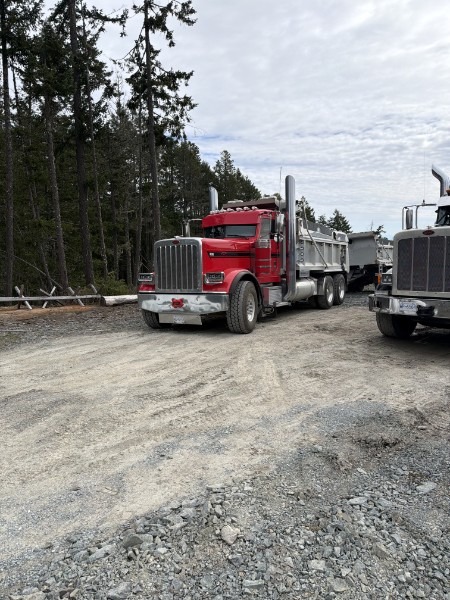
Photo context: Ronin Earthworks and RemitRight share an owner. The red Peterbilt in the yard photograph is a commercial-fleet illustration. The image establishes no engine model, warning, emissions fault or Langley repair.
Separate the filter, the fluid and the response
The diesel particulate filter, or DPF, captures particulate matter in the exhaust. Diesel exhaust fluid, or DEF, is used by selective catalytic reduction, or SCR, to help reduce nitrogen oxides. They are parts of an emissions-control system with different jobs. Cummins explains these functions in its public on-highway aftertreatment overview.
A derate describes a restriction in engine output or vehicle operation. It does not identify a failed component. DTNA's Cascadia engine-protection literature describes warning, derate and shutdown responses to several monitored conditions, including coolant, oil pressure and aftertreatment. The configuration and response depend on the vehicle. A reduced-power complaint should therefore include the full warning and the relevant vehicle identity, rather than an assumed “DPF problem.”
These distinctions explain how to describe a request. They do not establish which condition applies to your truck, whether it is safe to operate or whether regeneration is appropriate.
Capture the display before changing the story
Once safely stopped, record what is already visible. A photograph should show the whole message and lamp combination, not just a cropped number. Note the time and mileage. If a countdown or limit is displayed, copy its wording and units exactly.
- Which lamps are lit, and are they steady or flashing?
- What does the text message say, including any stop-engine wording?
- Is there a displayed power, speed or restart restriction?
- What was happening when the warning first appeared?
- Did the warning change after a normal shutdown or another event? Record the sequence without repeating actions to reproduce it.
Do not photograph the dash while driving. A checklist is not a reason to delay the response required by the vehicle's warning instructions. Use the operator's manual and appropriate service assistance for the actual warning.
Preserve the complete code record
If codes are already available through the vehicle display or an authorized scan, send the complete record with the source and capture time. Include the displayed manufacturer code, or SPN and FMI where given, and active or inactive status if the tool supplies it. “There was a code for emissions” is much less useful than the original report.
Keep related codes together. An isolated number copied from a web search loses the engine family, status and other observations needed for a useful interpretation. In its EPA07 aftertreatment manual, DTNA explicitly directs readers to the troubleshooting manual for the applicable engine platform. That historical reference is not a universal parts-replacement list or a code guide for a newer engine.
Tell the technician about any codes that were cleared, by whom and when. Do not clear or reset a system merely to make a warning disappear before an assessment. Preserving the record is useful even when the eventual repair concerns a different part than the operator first suspected.
Add the operating history that a code cannot supply
Record the engine model and serial information if known, vehicle year and model, fleet unit, mileage, recent repairs and the maintenance documentation you already have. Include recent DEF additions or aftertreatment work as events, without assuming that either caused the warning.
Describe the work cycle in ordinary terms: yard use, short trips, highway work or a recent change in use. Write down what actually happened, including any attempted regeneration and the observed result if one was already performed. Do not initiate a new regeneration to complete this worksheet. There is no universal parked-regeneration or reset sequence in this article.
Authorize evidence gathering before a component order
Ask the provider what the initial diagnostic scope covers, which engine platforms it can assess and how it will explain its findings. Agree the assessment cost basis, travel, minimum attendance charge and approval point for further work. Ask what documentation you will receive if testing is incomplete or workshop support is needed.
A useful report distinguishes the complaint, recorded codes, tests performed, findings and proposed next step. A warning that disappeared during attendance should be recorded as an observation, not automatically described as a completed repair. Retain supplier receipts separately if parts are purchased directly.
A BC worksheet and a disclosed local-service example
The recording method is useful to BC operators wherever their truck is located. Service coverage is a separate question. Langley Mobile Truck Repair shares an owner with RemitRight and serves its actual Lower Mainland area. Its mobile-diesel service page is an owner-affiliated starting point for checking diagnostic scope and availability, not an independent endorsement or a claim of service across BC.
Use its current pricing page and public contact, 778-887-5216, to confirm the terms for the exact request. Truck-service terms should not be carried across to a car or equipment enquiry without confirmation.
Sources and further reading
- Cummins: on-highway aftertreatment systems and component functions
- DTNA: Cascadia engine protection, warning and shutdown
- DTNA: diagnostic codes and applicable engine-platform manuals
- Langley Mobile Truck Repair: mobile-diesel service, owner-affiliated resource
- Langley Mobile Truck Repair: current pricing